
Menu
Learn how to build a systematic Investor BD pipeline for overseas fundraising. This framework covers investor mapping, warm intros, outreach, roadshows and AI-powered workflow to raise global capital effectively.
Fatdun Master
August 13, 2026
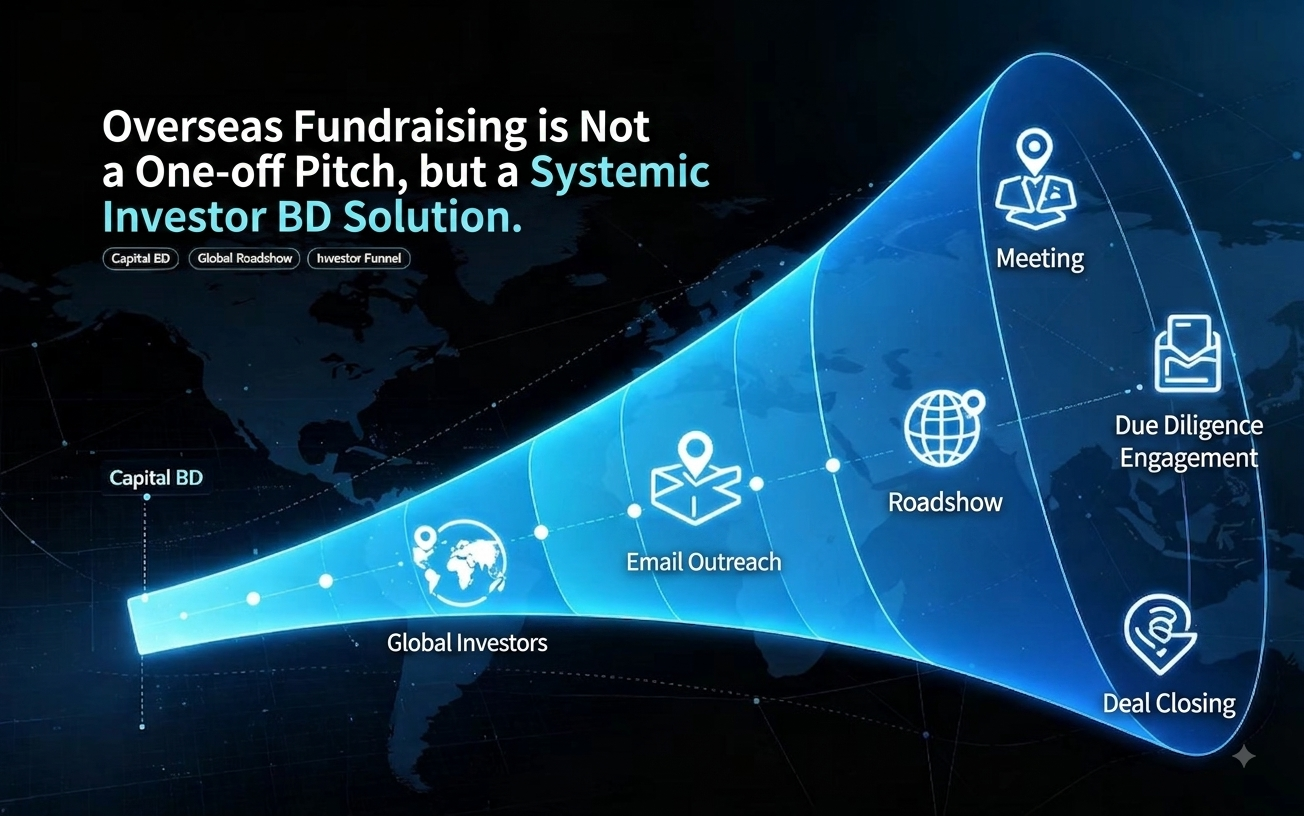
When many founders start overseas fundraising, their first move is usually to hire an FA. They send over the Pitch Deck, hoping the FA will source investors, set up meetings, and ultimately close the round.
Yet anyone with real overseas fundraising experience knows it is far more complex than that.
Overseas fundraising is not a one-off task of “finding investors”. It is an ongoing Investor Business Development (Investor BD) practice. From investor sourcing and screening, to online outreach and relationship building, offline roadshows, and consistent follow-ups, the whole process bears strong similarities to global B2B Business Development for enterprises.
That is why we prefer to frame overseas fundraising as Capital BD: a long-term business development system built around capital.
## 1. The First Step of Overseas Fundraising Is Not Hiring an FA, But Defining “Who You Are Looking For”
Many projects make this mistake from the start:
“Help me find overseas investors.”
But “overseas investors” is an extremely broad category. VCs, PEs, Family Offices, Angels, Corporate VCs and Strategic Investors all operate under fundamentally different investment logics.
Even among VCs alone, there can be massive discrepancies:
- Investment stage
- Focus sectors
- Geographic mandate
- Ticket size
- Target financing rounds
- Equity stake expectations
- Whether they back cross-border projects
- Capacity for follow-on investments
Therefore, the genuine first step is to build your Investor Profile.
Start by defining: Who should invest in us?
Example:
- Sector: AI / SaaS
- Stage: Seed / Series A
- Geography: US / Singapore / Middle East
- Check Size: $1M–$5M
- Investment Thesis: B2B SaaS / Enterprise AI
- Open to cross-border portfolio companies: Yes
- Require relevant portfolio track record: Yes
Only after locking in these criteria can targeted investor sourcing begin.
## 2. Build Your Investor Map
Once target parameters are set, the second step is to construct your Investor Map, namely your target investor landscape.
You can tier investors into three groups:
- Tier 1: Highly aligned investors
Perfect matches across investment thesis, stage, geography and ticket size. These are your top-priority targets for outreach.
- Tier 2: Potentially aligned investors
Matched on partial criteria, though your sector is not their core investment focus.
- Tier 3: Strategic investors
Beyond capital, they may bring:
- Customers
- Distribution channels
- Market access
- Industry resources
- Follow-on financing opportunities
- M&A pathways
This group is especially valuable for B2B enterprises.
A quality investor database is never simply “a list of 10,000 VC emails”.
What truly matters is identifying 100 investors who are genuinely a fit for your project.
## 3. Networks Remain Critical in Fundraising
The overseas market may seem open, yet fundraising is still a trust-driven industry.
One of the highest-conversion channels remains Warm Introduction.
Common warm intro routes:
Founder → Founder → Investor
Lawyer / Investor Advisor → Investor
Accelerator → Investor
Existing Investor → New Investor
This is why founders should cultivate their global network well before launching fundraising.
The real asset is not “knowing one investor personally”.
It is “being able to continuously access new investors through your network”.
## 4. Targeted Investor Outreach Works Even Without Warm Intros
In reality, warm introductions cannot be secured for every investor you target.
This makes Targeted Investor Outreach your second core capability.
Channels include:
- Cold Email
- LinkedIn
- X (Twitter)
- WhatsApp
- Founder communities
- Investor communities
- Event networking
A critical caveat: Do not confuse Investor Outreach with mass email blasting.
The effective workflow follows this sequence:
Investor Discovery
↓
Investor Qualification
↓
Deep Dive Research
↓
Personalized Outreach
↓
Conversation
↓
Formal Meeting
For instance, if an investor has recently backed a B2B SaaS startup highly adjacent to yours,
your opening message should not merely state: “We are raising $5M.”
You need to help them instantly see why your company fits their investment mandate.
This marks the key distinction between Investor BD and generic mass marketing.
## 5. The Goal of Online Outreach Is Not to Close Funding Digitally
This is a common misconception among many teams.
Cold Email, LinkedIn, X and other online channels rarely exist to fully convince an investor remotely.
Their core purpose is to turn cold connections into familiar ones and move the relationship forward.
You can frame digital fundraising as: Discovery → Engagement → Meeting
LinkedIn connection request
↓
Share Company Profile
↓
Investor responds
↓
Email dialogue
↓
Online meeting
↓
Offline meeting
Online touchpoints act as the gateway; meetings drive relationship escalation.
## 6. Offline Roadshows Remain Indispensable for Overseas Fundraising
Globalization has not rendered offline roadshows obsolete.
On the contrary, once preliminary rapport is built online, in-person meetings often become a pivotal milestone to deepen trust.
Opportunities include:
- VC Conferences
- Investor Summits
- Demo Days
- Industry Conferences
- Family Office Events
- Private Investor Dinners
- Regional Roadshows
- One-on-One Investor Meetings
An efficient roadshow is not: “Fly to a country and meet dozens of completely unfamiliar investors.”
A far higher-impact playbook: pre-screen investors online → nurture initial contact → lock in meetings in advance → batch in-person sessions while on the ground.
This drastically lifts roadshow ROI.
## 7. Fundraising Materials Extend Far Beyond a Pitch Deck
Many founders reduce fundraising collateral to a single PowerPoint deck.
Yet investors require a much broader set of information.
A complete Fundraising Package typically includes:
- Company Profile: Core business overview
- Pitch Deck: Investment merit narrative
- Financial Model: Commercial and financial projections
- Investor FAQ: Preemptive answers to common questions
- Data Room: Due diligence documentation
- Product / Demo: Proof of product capability
- Traction: Customers, revenue, growth metrics and user KPIs
- Market Information: TAM, SAM, SOM and competitive landscape
Fundraising BD and collateral preparation are two workstreams that must advance in parallel.
## 8. Follow-Up Is the Most Overlooked Step for Fundraising Teams
A frequent scenario: A founder has one productive call with an investor, then lets the conversation stall.
Or, “The investor said they will review the materials” — and there is no check-in for a full month.
This represents massive lost opportunity.
Investment decisions are almost never sealed in a single meeting.
You need to operate an Investor CRM to track:
- Investor name & fund
- Contact details
- Investment thesis
- Last contact date
- Meeting logs
- Investor feedback
- Next action items
- Scheduled follow-up date
- Investment pipeline status
Pipeline stages:
Contacted
↓
Replied
↓
First Meeting
↓
Follow-up
↓
Partner Meeting
↓
DD
↓
Term Sheet
Fundraising operates like a sales pipeline.
## 9. Why Relying Solely on an FA Is Usually Insufficient
FAs deliver clear value. A strong FA can provide:
- Investor networks
- Fundraising expertise
- Deal execution experience
- Industry connections
- Warm introductions
But an FA should be treated as one important channel within your Investor Network — not your entire fundraising system.
A holistic overseas fundraising system covers multiple modules:
ModuleCore QuestionInvestor MappingWho are we targeting?Investor QualificationWhich investors are the best fit?Warm IntroductionWho can make introductions for us?Online OutreachHow do we initiate contact?Investor EngagementHow do we nurture relationships?RoadshowHow do we arrange in-person meetings?MaterialsHow do we articulate our value clearly?CRMHow do we sustain follow-ups?DDHow do we advance the transaction?
The right question is not “Should I hire an FA?”
It should be: “Beyond an FA, have I built my own Investor BD capability?”
## 10. Build a Full Investor BD Funnel for Overseas Fundraising
End-to-end, the workflow forms a complete funnel:
Fundraising Strategy
↓
Investor Profile
↓
Investor Mapping
↓
Investor Qualification
↓
Warm Introduction + Cold Outreach
↓
Online Engagement
↓
Investor Meeting
↓
Roadshow
↓
Follow-up
↓
Due Diligence
↓
Term Sheet
↓
Closing
A breakdown at any stage can derail fundraising outcomes.
Examples:
- Misaligned investor targeting → low response rates
- Poor outreach framing → no replies at all
- Unclear fundraising materials → no next steps post-meeting
- Lack of structured follow-up → investor interest fades
- No in-person relationship building → difficulty building deeper trust
Fundraising is not a standalone skill. It is an end-to-end pipeline.
## 11. AI Is Reshaping Investor BD Efficiency
In the past, global investor coverage required heavy manual work:
Search for investors
Profile investment firms
Map investment theses
Analyze portfolios
Source contact details
Draft emails
Run LinkedIn outreach
Track replies
Schedule meetings
Update CRM
Today, AI Agents can automate much of this workflow:
- Investor Discovery Agent: Continuously surface investors matching your criteria
- Investor Matching Agent: Score alignment between investor track record and your startup
- Investor Research Agent: Analyze investment thesis, portfolio, recent deals, geography and ticket size
- Outreach Agent: Generate personalized outreach copy tailored to each investor
- Follow-up Agent: Trigger reminders and nurture long-term relationships
- Roadshow Agent: Identify relevant events and coordinate meeting slots
One critical caveat: AI boosts Investor BD efficiency, but it cannot fully replace human relationship-building with investors.
Fundraising remains deeply trust-dependent.
AI is best suited for Discovery, Research, Qualification, Outreach and Follow-up.
Founders, FAs, Advisors and your team still own Trust-building, Pitching, Negotiation, Relationship Cultivation and Closing.
## 12. Why Sifted Network Focuses on This Scenario
This is the core question Sifted Network has been exploring: Can global BD for enterprises be systematized?
Traditional BD is often simplified to: recruit salespeople, find channels, acquire customers, attend events, send emails and follow up.
Yet enterprises pursue many other types of commercial opportunities:
Customers
Partners
Distributors
KOLs
Strategic Partners
Investors
All of these qualify as Business Opportunities.
Fundraising serves as a highly representative use case.
For capital-seeking startups, Sifted Network supports the full workflow:
Investor Discovery → Investor Matching → Investor Outreach → Investor Engagement → Roadshow → Follow-up
For other enterprises, we enable identical BD workflows targeting customers, partners, distributors and strategic resources.
## Closing Remarks: Overseas Fundraising Is Not a Single Pitch — It Is a Long-Running Investor BD Campaign
The biggest myth around overseas fundraising: “Hire an FA and wait for investor leads.”
High-performance fundraising functions more like an ongoing global BD Campaign.
Your sequence:
Source the right investors
↓
Build your target investor map
↓
Activate warm intros and targeted cold outreach
↓
Build rapport online
↓
Secure investor meetings
↓
Organize offline roadshows
↓
Execute consistent follow-ups
↓
Advance into DD
↓
Close the transaction
Therefore:
An FA is a channel, not the entire solution.
A roadshow is a milestone, not the whole strategy.
Cold Email is a tool, not the full playbook.
What truly matters is building a sustainable Investor BD system to continuously discover, reach, connect and nurture global investor relationships.
For startups raising overseas capital today, building this system deserves higher priority than simply searching for “someone who can introduce investors”.
Official Website: sifted.network
WeChat: 956771470
© 2026 Sifted Network. AI-powered Business Development Network.